
Sr.KG Experiment: Life Cycle of a Butterfly on 17th September 2025
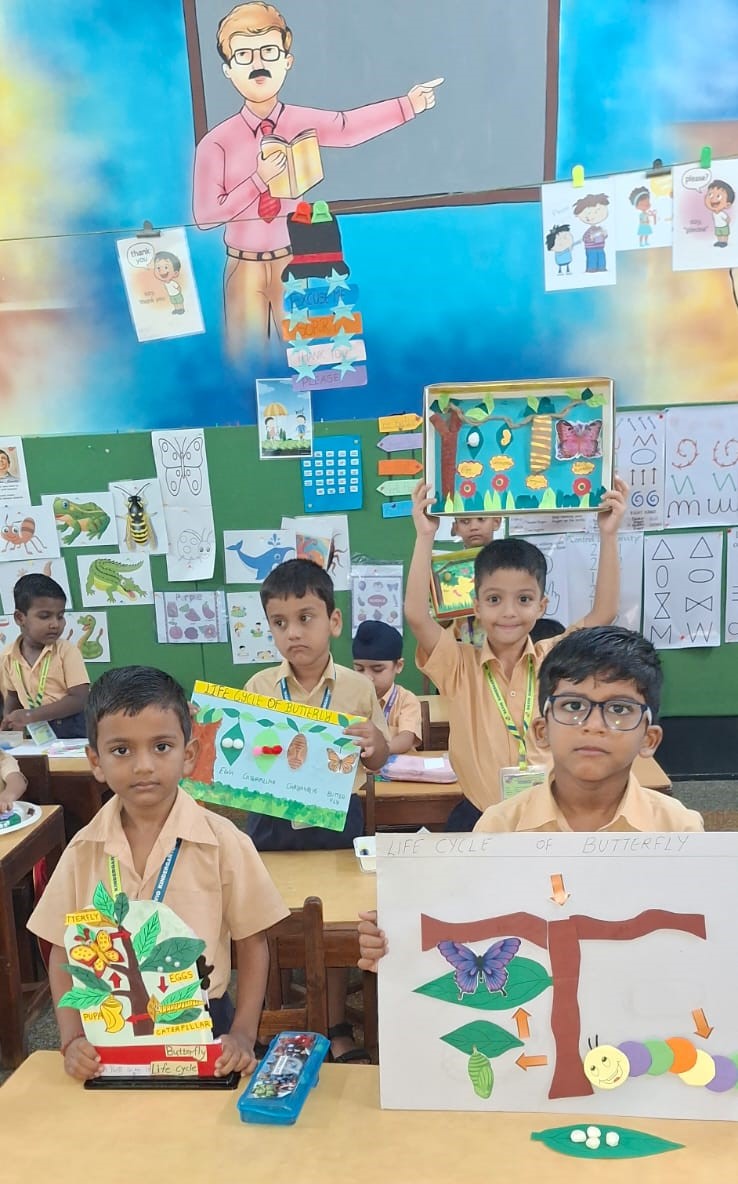
“Just when the caterpillar thought the world was over, it became a butterfly.” 
The children were first introduced to the Life Cycle of a Butterfly in class. Later, they were asked to bring the required materials to carry out the activity. The activity was conducted on 17th September 2025.
All the children came well prepared. The topic was once again explained by their teacher, and the students were excited and eager to complete their project work using materials like small pom-pom balls, cut-outs, and colourful craft supplies.
Step by step, the children recreated the stages of the butterfly’s life cycle:
1. Egg Stage
Female butterflies lay eggs mostly on the underside of leaves.
Eggs are very tiny (some look like dots) and may be round, oval, or cylindrical, depending on the species.
The egg shell protects the baby caterpillar inside.
Duration: Usually 3–7 days, but in some species it may take longer.
2. Caterpillar Stage
When the egg hatches, a caterpillar (larva) comes out.
Its main job is to eat and grow. Caterpillars eat the leaves of the host plant almost non-stop.
They shed their skin several times as they grow.
Duration: 2–4 weeks, depending on the species and environment.
3. Chrysalis / Pupa Stage
When the caterpillar is fully grown, it finds a safe place and forms a chrysalis (pupa).
Inside, a wonderful change takes place.
The caterpillar’s body transforms into the parts of a butterfly: wings, antennae, legs, and proboscis.
Duration: About 10–14 days, but some species can stay in this stage for months (especially in cold weather).
4. Adult Butterfly Stage
Finally, the adult butterfly emerges from the chrysalis.
At first, its wings are soft and crumpled. The butterfly pumps fluid into them, and within a few hours, the wings become strong and ready for flight.
Adult butterflies drink nectar from flowers.
Their main purpose as adults is to reproduce and continue the life cycle.
Lifespan: Some butterflies live only 2–3 weeks, while Monarch butterflies can live for several months.
The activity encouraged children to learn by doing. They developed fine motor skills while sticking and placing the materials in the correct place, and showed creativity in arranging them to make colourful butterflies.
At the same time, they practiced listening carefully and following step-by-step instructions.
The classroom atmosphere was filled with enthusiasm and curiosity. Many children asked thoughtful questions about the process, showing their eagerness to understand nature more deeply. Teachers observed that even the quieter students participated actively and could confidently explain the stages of the butterfly’s life cycle by the end of the session.
The experiment was thoroughly enjoyed by all the children and teachers. The joy on their faces reflected their excitement and learning. This hands-on activity not only helped the children understand the concept better but also inspired them to appreciate the beauty of transformation and growth in nature.